6 Leading AI Customer Service Platforms in 2026
Leading AI Customer Service Platforms: practical 2026 comparison with decision criteria, risks, implementation steps, and related AI agent tools.
This updated guide reframes 6 Leading AI Customer Service Platforms in 2026 around practical search intent: what readers need to compare, choose, install, secure, or operationalize in 2026. It focuses on decision criteria, workflow fit, and the trade-offs that matter once an AI agent, skill, marketplace, or automation moves from curiosity to daily use.
The article also broadens the semantic coverage around AI customer support agent, ticket triage, support automation. That gives readers a clearer path from high-level research to implementation planning, while keeping the content useful for teams evaluating AI customer support automation.
Quick Answer
Prioritize tools that classify intent accurately, preserve customer context, route tickets with confidence, and hand off edge cases before service quality drops.
It is a challenging situation, but AI customer service tools can make a genuine difference here. They deliver around-the-clock assistance, resolve common inquiries on the spot, and help the entire operation function more efficiently.
The market is filled with AI-powered solutions, and distinguishing between basic chatbots and sophisticated platforms that deploy quickly can be difficult.
This guide offers a straightforward assessment of the six best AI customer service platforms available in 2026. We examine their features, pricing, and ideal use cases so you can identify the right match for your team.
What defines the best AI customer service tools?
Forget outdated, rule-based chatbots that only responded when you typed the exact keyword. Modern AI customer service tools operate in an entirely different league. They leverage generative AI and machine learning to comprehend what customers are truly asking, maintain natural conversations, and automate tasks that previously consumed hours of agent time.
They generally fall into three primary categories:
- Intelligent self-service and autonomous agents: This is your frontline defense. Picture a customer-facing AI agent, such as the eesel AI Agent, capable of managing a support ticket from start to finish without any human assistance. It diagnoses the problem, locates the answer, and closes the ticket.
- AI agent assistance (Copilot): These tools serve as a sidekick for your agents. An AI Copilot collaborates with your team to draft replies, summarize lengthy conversations, and surface the right information to help resolve problems much faster.
- Behind-the-scenes automation (AI triage): This is the AI handling all the unglamorous operational work. It automatically tags tickets, routes them to the correct person, and eliminates spam or simple "thank you" messages cluttering the queue. We refer to this as AI triage.
Evaluation criteria for top AI customer service tools
To compile this list, we concentrated on what genuinely matters to a support team: practical usefulness, deployment speed, and total cost. We looked past the hype and focused on features that deliver real impact.
Ease of setup and training: How rapidly can you begin using it? Does the AI learn from your existing help center and past tickets with a simple click, or will you need a developer and a six-month implementation plan?
Automation depth: Can it only handle simple questions, or can it actually perform actions? We evaluated capabilities like processing a refund, checking an order status in Shopify, or creating a ticket in Jira.
Agent assistance: How much does it genuinely help your human agents? Does it provide useful drafts and summaries, or just generic, robotic suggestions?
Integration capabilities: How smoothly does it connect with your current tools? We assessed connections to popular help desks like Zendesk or Freshdesk, knowledge bases like Confluence, and e-commerce platforms.
Customization and control: Can you easily instruct the AI on what to do and when to escalate to a human using plain English? Or are you limited to clunky, outdated workflow builders?
Side-by-side comparison of leading AI customer service tools in 2026
| Tool | Best For | Key AI Feature | Ease of Setup | Pricing Model |
|---|---|---|---|---|
| eesel AI | Teams seeking a collaborative AI teammate that learns from existing data | Autonomous resolution and agent assistance from historical tickets | Minutes (one-click integrations) | Interaction-based (starts at $299/mo) |
| Zendesk | Enterprise teams requiring a comprehensive, all-in-one platform | Agentic AI for omnichannel resolution and advanced admin tools | Comprehensive (designed for scale) | Per agent + modular AI features |
| Intercom (Fin) | Businesses invested in the Intercom ecosystem | Conversational AI for complex queries | Easy to moderate | Per resolution + per seat |
| Kustomer | Companies needing a unified CRM and AI platform | AI fueled by a 360-degree customer view | Moderate to complex | Per seat (8-seat minimum) |
| Freshdesk (Freddy AI) | Teams requiring broad, omnichannel bot deployment | Freddy AI Agent and Copilot with vertical-specific workflows | Comprehensive and reliable | Per agent + AI add-ons |
| Gorgias | E-commerce stores on Shopify | AI-driven sales and support automation | Easy (deep Shopify focus) | Ticket volume-based |
The 6 leading AI customer service platforms in 2026
Here is our detailed breakdown of the best AI tools for the year ahead.
1. eesel AI
eesel AI positions its AI as a "teammate" you onboard, rather than a tool you configure. Instead of a complex process, you simply connect it to your help desk (such as Zendesk or Intercom) and knowledge sources (Confluence, Google Docs) with a single click. It then reads all your historical tickets, help articles, and internal documentation to learn your business within minutes.
This enables a gradual rollout. You can start with eesel as an AI Copilot that drafts replies for your agents. Once you are satisfied with its performance, you can "promote" it to a fully autonomous AI Agent. As one customer noted, "We now have 3 eesel AI agents in Intercom that triage and respond."
Pros: Setup is remarkably fast and requires no developer. You can safely test the AI on past tickets before it interacts with an actual customer, which is an enormous advantage. Controls are straightforward, allowing you to set rules in plain English, and pricing is transparent with no per-agent fees.
Cons: As a dedicated AI platform, it lacks the built-in workforce management or advanced native reporting found in a comprehensive all-in-one suite like Zendesk.
Pricing:
Team plan: Starts at $299/month for 1,000 AI interactions. Business plan: $799/month for 3,000 interactions, adding key features like training on historical tickets.
- A 20% discount is available on annual plans.
2. Zendesk
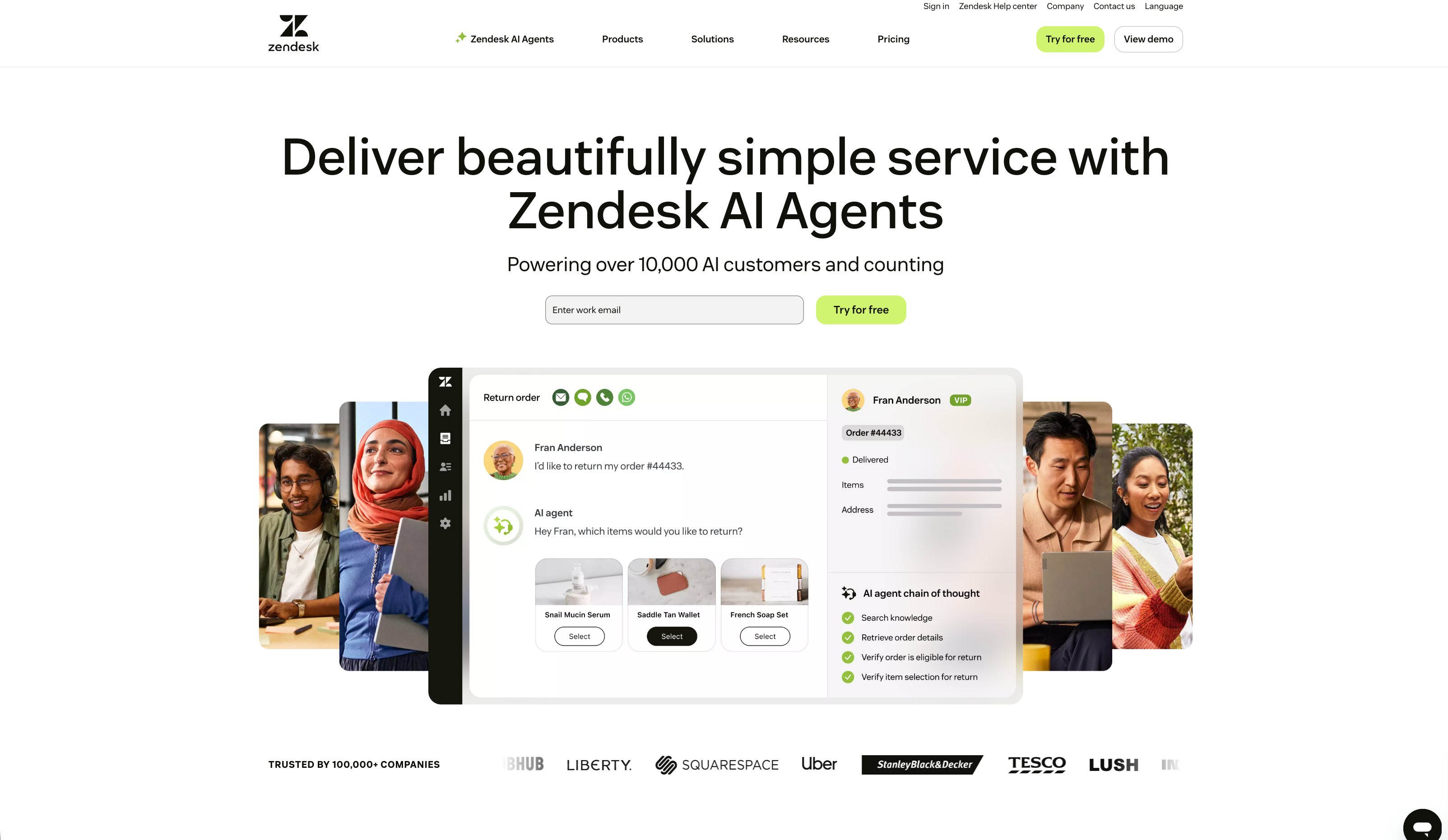
Zendesk is an all-encompassing platform built for large, established support organizations. Recognized as a Gartner Magic Quadrant Leader, its AI is part of a much broader suite that encompasses everything from advanced ticketing and reporting to workforce management. Zendesk's AI is "agentic," meaning it handles complex conversations across multiple channels, including voice.
Pros: It is a genuine all-in-one platform with substantial power and scalability. If you operate a massive support organization, it provides virtually everything you could need. Trusted by over 100,000 companies, it remains a safe choice for businesses seeking a mature, dependable ecosystem.
Cons: The platform's extensive capabilities offer deep customization, which means getting it precisely tailored can require some time. Additionally, many of its powerful AI features, like Copilot, are available as modular additions to per-agent plans, allowing teams to scale their toolkit as needed.
Pricing:
- The Suite Team plan starts at $55 per agent, per month (billed annually).
- AI add-ons are priced separately. For instance, their Copilot costs an additional $50 per agent, per month.
3. Intercom (Fin)
Intercom's Fin is renowned for its conversational quality. Powered by Intercom's proprietary Fin AI Engine, it excels at extracting information from your help center to deliver detailed, human-like answers to complex questions. It is designed to work seamlessly within the Intercom ecosystem, though you can also deploy it as a standalone bot on other help desks.
Fin (Intercom) sometimes struggles not only because of hallucinations, but because it cannot manage multi-step workflows effectively: built as a single agent without sub-agents or specialized roles, it loses context quickly.
Pros: It delivers an exceptional conversational experience for detailed inquiries. If you already use Intercom's messenger and help desk, the integration is seamless.
Cons: The pricing model is a key consideration for many teams. At $0.99 per resolution, costs can become variable with large ticket volumes, which may require careful budget planning.
Pricing:
- You are billed $0.99 for each AI resolution.
- This is in addition to your base Intercom platform subscription, which starts at $29 per seat, per month.
4. Kustomer
Kustomer's entire approach revolves around its unified CRM, providing a single timeline of every customer interaction. This rich, 360-degree view powers its AI, enabling highly personalized and context-aware conversations. Kustomer's AI manages chats on any channel, including voice, and assists representatives by summarizing conversations and suggesting responses.
Pros: Having all customer data consolidated in one place produces smarter AI and more efficient agents. For data-focused businesses, it is a powerful and highly customizable platform.
Cons: Pricing targets mid-market and enterprise companies. An 8-seat minimum on its plan makes it inaccessible for smaller teams. Some users also mention a steep learning curve.
Pricing:
- The Enterprise plan starts at $89 per user, per month (billed annually, with that 8-seat minimum).
- AI features are add-ons. The AI Agents for Customers starts at $0.60 per engaged conversation.
5. Freshdesk (Freddy AI)
Freshdesk's AI solution, named Freddy, comes in two variants: a customer-facing agent and an internal copilot for your team. It supports omnichannel deployment, so you can run AI across email, chat, social media, and even voice. Freddy also provides "Vertical AI Agents" with pre-built workflows for specific industries like e-commerce or travel, accelerating your initial setup. As a mature and dependable platform, Freshdesk powers customer service for thousands of companies worldwide.
Pros: It features a broad range of capabilities and supports over 60 languages, making it well-suited for global teams. Freshdesk has cultivated an impressive ecosystem and marketplace, and the pre-built workflows provide a great way to get started quickly.
Cons: Freshdesk employs a flexible, modular approach to its AI features. While some advanced capabilities like the Freddy AI Copilot are available as add-ons, this tiered structure lets teams scale their investment and features precisely as their support needs evolve.
Pricing:
- Omnichannel plans with AI start at $29 per agent, per month (billed annually).
- Freshdesk offers various tiers to suit different team sizes. The Freddy Copilot add-on starts at an additional $29 per agent, per month. The Freddy AI Agent costs $49 per 100 sessions after you exhaust your initial 500 free sessions.
6. Gorgias
As a mature and dependable platform powering customer service for thousands of brands, Gorgias is an industry leader built specifically for e-commerce with deep Shopify integration. Its AI is designed as a "Shopping Assistant" that both supports customers and drives additional sales. It handles common e-commerce inquiries like "Where is my order?", processes returns, and even edits orders directly in Shopify. It also proactively recommends products to customers to boost conversions.
Pros: If you operate a Shopify store, the seamless integration is a significant advantage. It allows your agents and the AI to take important actions without leaving the help desk. It excels at transforming your support team into a revenue generator and automates up to 60% of common inquiries. Gorgias has established an impressive marketplace and ecosystem, making it the gold standard for retail support.
Cons: While it is laser-focused on the e-commerce experience, which means it prioritizes specialized retail features over generic support tools, Gorgias remains the most capable option for online merchants. Its pricing also provides tiered plans to accommodate different team sizes as you scale.
Pricing:
- Pricing is based on the number of billable tickets each month. The Basic plan starts at $50/month for 300 tickets.
- Gorgias offers tiered plans for different team sizes, and the AI Agent is priced separately, starting at $0.90 per resolved conversation on most plans.
How to select the right AI customer service tool for your team
Determine your actual requirements. What are you trying to accomplish? Do you want to fully automate your support, or do you simply need something to help your agents work faster? If you seek true, hands-off automation, find a tool that goes beyond just drafting replies. Platforms like eesel AI provide both an autonomous AI Agent and an agent-assist AI Copilot in one package that complements your existing help desk.
Evaluate your existing knowledge. The best AI tools do not force you to start from scratch. They learn from the knowledge you already possess. A platform that can instantly connect to your help desk and read your historical tickets, help center articles, and internal documentation will deliver value much faster.
Prioritize control and safety. Seek a solution that lets you test its performance on your data before it ever communicates with a customer. A gradual rollout, moving from supervised to fully autonomous, is the safest approach to introducing AI into your workflow. This simulation capability is a core feature of eesel AI.
Look beyond the per-agent price. Some platforms, like Freshdesk and Zendesk, offer their advanced features as modular add-ons, enabling a high degree of customization as your requirements evolve. Consider the total cost and look for transparent, usage-based models that provide different types of flexibility as you scale your team.
For a deeper exploration of the best AI customer service software available in 2026, including AI agents, the accompanying video provides a helpful market overview.
Selecting the ideal AI customer service tool
The AI customer service landscape has moved far beyond clunky bots. Today's best tools can genuinely resolve customer problems, equip your agents with new capabilities, and elevate the entire support experience.
The right choice depends on your needs, whether that is a trusted industry leader like Gorgias for e-commerce, a comprehensive enterprise platform like Freshdesk, or a flexible AI layer like eesel AI that operates within your existing ecosystem.
For teams interested in an AI that functions like a teammate, eesel AI offers a solution that learns from your existing data and can be deployed incrementally. You can explore how it works with a free 7-day trial.
Frequently asked questions
Related Reading
更多文章
10 Best AI Agent Hosting Platforms Compared (2026)
Best AI Agent Hosting Platforms Compared: compare deployment, storage, pricing, governance, and operations trade-offs for production AI agent teams in 2026.
OpenClaw Security Risks: Skills, Exposure and Exploits 2026 Guide
OpenClaw Security Risks:: review AI agent security risks, malicious skills, MCP exposure, governance controls, and safer deployment patterns for 2026.
AI Support Ticket Triage Strategies: Enterprise Playbook 2026
AI Support Ticket Triage: compare ticket triage, routing, customer support automation, implementation patterns, and buyer criteria for service teams in 2026.